Two College Faculty Named Finalists for Bank of America Award for Teaching Excellence, the University’s Top Teaching Award
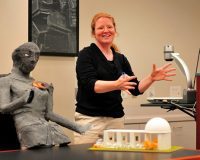
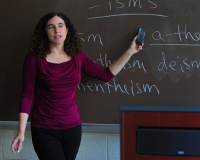
(Pictured, left to right: Aliaga-Buchenau, Robinson.)
Two faculty members from the College of Liberal Arts & Sciences are among the five finalists for UNC Charlotte’s top teaching award, the 2012 Bank of America Award for Teaching Excellence.
Anabel Aliaga-Buchenau, associate professor of German and comparative literature, and Joanne Robinson, associate professor of religious studies, join Sunil Erevelles, associate professor of marketing, Belk College of Business; Hal Jaus, professor of reading and elementary education, College of Education; and Michael Turner, associate professor of kinesiology, College of Health and Human Services, as finalists. The university will name the recipient of the honor at a reception on Friday, Oct. 19.
Aliaga-Buchenau
Aliaga-Buchenau is credited with much of the success of the German program, as its coordinator and “lifeblood,” says Robert Reimer, chair of the Department of Languages and Culture Studies. Her success results from her leadership and ability to adapt to the “changing pedagogical landscape in today’s electronic and globalized world and to her incredible energy showcased in her classroom teaching and mentorship of each and every one of her students,” Reimer says.
Teaching is “the ability to reach people, to open new worlds to them…and to participate in their journey,” Aliaga-Buchenau says. She has opened physical and intellectual worlds for students by creating study abroad opportunities, which have proven important to the successful recruitment and retention of German majors at UNC Charlotte. Through a partnership with the German Language and Culture Foundation, she procured more than $60,000 in three years to send 35 students to Germany for one month of intensive language instruction.
Aliaga-Buchenau also leads short-term study abroad programs to Europe. The most meaningful, emotional and memorable course she has taught occurred when she traveled with students to Berlin and the Auschwitz-Birkenau concentration camp in Poland in 2011. She and the students toured Auschwitz with faculty emeritus Susan Cernyak-Spatz and listened as she recounted her experiences as a prisoner there. For Aliaga-Buchenau, the Holocaust is an important element of her German identity, and she has made it her mission to ensure that those who enter her classroom confront the human capacity to commit, and also to overcome, horrific atrocities. She helped design the minor in Holocaust, Genocide and Human Rights housed in the Global, International and Area Studies Department to teach the importance of tolerance.
Aliaga-Buchenau has described herself as a teacher in every aspect of her daily life. The university community has recognized this commitment to teaching. She is the Bonnie E. Cone Early Career Teaching Professor for 2009-12, an award that honors superior achievement in teaching among new faculty. One of her students described Aliaga-Buchenau as a professor who “injects students with knowledge and practice and infects them with enthusiasm for and a desire to learn German.” Without her presence, the student says, “I would lack the direction and confidence I have gained not only as a student, but as a person.”
A mentor to her students, Aliaga-Buchenau assists with applications for jobs or graduate school. Her former students use their language abilities in graduate programs and work environments across the United States and throughout the world, including with schools and companies in Australia, Germany, Saudi Arabia and Poland.
Robinson
For Robinson, transparency is the key to her success as a teacher. By ensuring that the goals and outcomes of a course are transparent, she establishes a classroom ethos of mutual respect and high expectation. She extends this engaged and collegial intellectual atmosphere beyond the classroom. Her students describe weekly informal gatherings hosted by Robinson in which interested graduate and undergraduate students stop by her office to ask questions, discuss related issues and exchange ideas.
Students describe this as a productive environment for intellectual interaction. “Dr. Robinson brings enthusiasm and openness to active student engagement that encourages a free exchange of ideas and diversity of perspective that make the course material accessible and interesting,” one graduate student wrote. By creating a stimulating environment, Robinson has been able to cultivate a practice of intellectual courage and creativity among her students, achieving her goal of instilling “analytical sophistication about complex issues, even in the absence of solutions or agreement.”
Over time, Robinson’s teaching approach has evolved, as she realized that the classroom is a space where students can begin to explore new identities and ideas. This recognition allowed Robinson “to embrace a vision of the classroom as a place for learning how to take chances, for testing out new knowledge and for playing with ideas.” By designing differentiated assignments and new platforms for instruction, she could “stretch the walls of the classroom creatively into the world.”
Since joining the Department of Religious Studies in 1996, Robinson has received a number of teaching-related awards and grants. Most recently, Robinson Most recently, the National Endowment for the Humanities awarded her a grant to develop a course focused on the question “How is the World Ordered?”
She earned the B.E.S.T. (Building Educational Strengths and Talents) Award for Excellence in Teaching in 2008, as a result of a nomination by her students. In 2010-11, she became a University College Faculty Fellow.
Indiana’s Wabash Center, an institution dedicated to promoting a sustained conversation about pedagogy in the fields of religion and theology, awarded Robinson a grant to participate in the Wabash Center Mid-career Colloquy for Faculty Teaching in Colleges and Universities in 2008-09. She also received an award to participate in the Wabash Center Colloquy on Writing on the Scholarship of Teaching (2010-11), for which she engaged in a year-long process of critical reflection on writing in the areas of teaching and learning.
“I think I can say without the slightest exaggeration that no faculty member I know of, in our department or outside of it, has had more of a high quality educational, inspirational and life-mentoring influence on students than Professor Joanne Robinson,” says Dr. James Tabor, chair of religious studies.