Greg Weeks joined WCNC+ to provide expertise on the unfolding situation in Venezuela
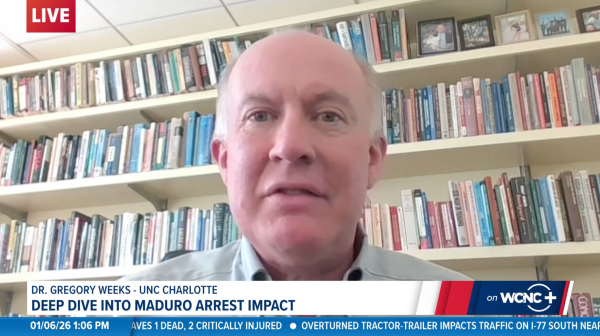
Greg Weeks, associate dean in the College of Humanities & Earth and Social Sciences and expert in Latin American politics, discussed the unfolding situation in Venezuela on WCNC+’s “Live Impact Afternoon News” show.
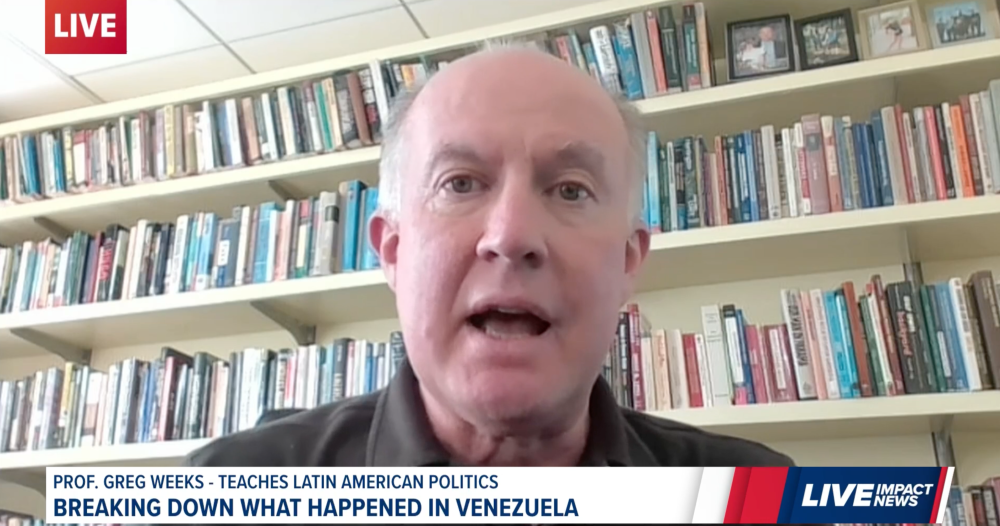
Weeks joined WCNC+ for two live interviews. The first took place on Monday, Jan. 5, where he unpacked the U.S. capture of Venezuelan President Nicolás Maduro, Maduro’s presidency and the United States’ history of intervention. During the second interview on Tuesday, Jan. 6, Weeks discussed the current state of Venezuela after Maduro’s capture.
Maduro’s presidency and capture
Maduro became president of Venezuela following Hugo Chavez’s death in 2013. In the 2018 presidential election, he declared victory despite allegations of vote buying and electoral fraud.
In 2024, Maduro declared himself president over opposition candidate Edmundo González, despite another contested election and allegations of illegitimacy. The United States and many other countries refused to recognize Maduro as the legitimate president.
“Over time, his presidency has become increasingly authoritarian, cracking down very hard on anyone who protests against the government, stealing elections — the last presidential election was very clearly stolen — and basically attacking anyone who doesn’t support the government,” said Weeks. “Politically, Venezuela has been a dictatorship without rule of law for quite some time.”
The U.S. Department of State details that Maduro was charged in March 2020 for “narco-terrorism, conspiracy to import cocaine, possession of machine guns and destructive devices, and conspiracy to possess machine guns and destructive devices.” These charges are in connection to his alleged leadership of the Cartel of the Suns, a Venezuelan drug-trafficking organization sanctioned as a Specially Designated Global Terrorist by the Department of Treasury.
Many Venezuelans and people around the world celebrated when U.S. forces captured Maduro, but many also remained hesitant of the U.S. intervention due to concerns about Maduro’s vice-president continuing his regime and the future of Venezuela’s oil infrastructure.
“I think nobody is sorry that Maduro is gone, or very, very few are, he is not a well-liked person,” said Weeks. “With that said, the way in which it happened, which was that he was forcibly removed from the country, has raised alarms regarding what kind of precedent that sets for other countries.”
Current state of Venezuela
Maduro and his wife, Celia Flores, both pleaded “not guilty” in New York after they were captured in the surprise attack, with Maduro stating that he is a prisoner of war. The situation is similar to other instances of the U.S. intervening in Latin America including Cuba, Haiti, Honduras and Panama.
However, Weeks explained that when the U.S. has captured foreign leaders in the past, citing drug trafficking and oppressive regimes as justification, American troops usually remained in the country to ensure the transition of power and alignment with U.S. requirements.
“What we’ve seen, unlike a lot of U.S. invasions in the past, is a very quick military operation to remove a president that does not leave U.S. troops on the ground,” Weeks said. “So we have this interesting situation where you have a dictatorship, and the dictatorship is completely still in power. The vice-president was very close to Maduro, so it’s not exactly clear what has changed in Venezuela itself and we will have to see how the Trump administration maintains control over Delcy Rodríguez from afar.”
Future precedent
There are concerns around the world about what precedent this situation set in regards to international law and the sovereignty of other countries. The conversation of U.S. control over Greenland has come back up in the aftermath, with President Trump doubling down that it is an issue of national security.
“President Trump has been interested in obtaining Greenland for a long time, but it’s different because it’s part of a democratic country, an autonomous region of Denmark,” said Weeks. “It’s certainly not a dictatorship, it has not violated the rights of its own people, it’s just simply something that the president wants.”
Greenland is under the protection of NATO, of which the U.S. and Denmark are both members. U.S. control over Greenland would require a wide-scale invasion, as Denmark is strongly opposed and has the backing of other NATO countries.
“Obtaining Greenland would be an act of war so that’s why you see a lot more opposition to discussions about Greenland, even more so than with Venezuela,” Weeks stated.
Watch the discussion from Monday, Jan. 5: “Professor breaks down what happened in Venezuela”