Global Diplomat Addresses “Middle East Peace” at Lecture Hosted by College of Liberal Arts & Sciences at UNC Charlotte Center City
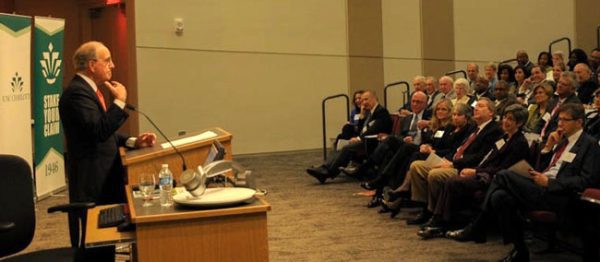
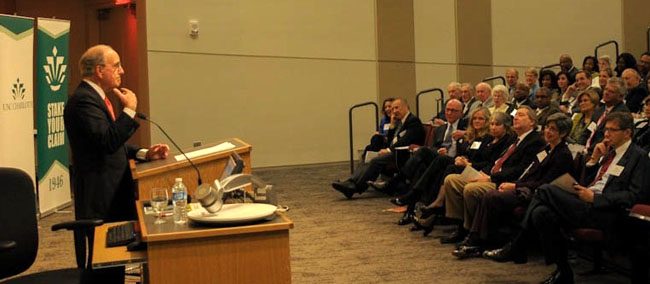
Global diplomat, peace negotiator and leadership expert George Mitchell spoke to a capacity crowd on “Turmoil in the Middle East and its Effect on American Policy” at UNC Charlotte Center City on February 1 at 6 p.m. The College of Liberal Arts & Sciences was the host college for the event, which was the inaugural lecture in an annual series.
Close to 300 students, faculty and staff from UNC Charlotte and members of the public gathered for the remarks by former U.S. Special Envoy for Middle East Peace Mitchell. In addition to the public lecture, Mitchell held an earlier question-and-answer session with UNC Charlotte students.
“Former Senator Mitchell has had significant influence on many issues of national and global importance,” said Nancy A. Gutierrez, dean of the College of Liberal Arts & Sciences. “We were honored to be the host college for this inaugural lecture, and we were thrilled so many people from our university and community could join us.”
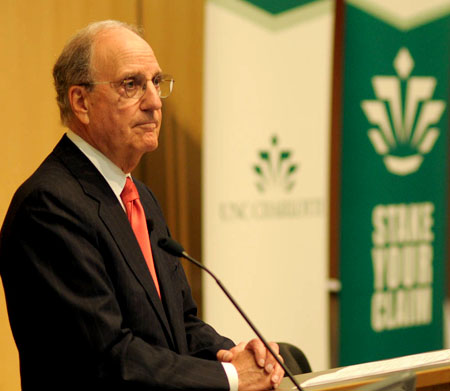 Mitchell has been called on by presidents, prime ministers and corporate and sports leaders to handle the delicate issues of peace negotiation, conflict resolution or independent, high-profile commissions. In 2008, “TIME Magazine” named him one of the 100 most influential persons in the world.
Mitchell served as U.S. Special Envoy for Middle East Peace from January 2009 to May 2011. He was appointed to the U.S. Senate in 1980 to fulfill an unexpired term and was elected to a full term in 1982. Mitchell left the Senate in 1995 as the Senate majority leader, a position he had held since January, 1989.
In 1995, he served as a Special Advisor to President Clinton on Ireland, and from 1996 to 2000 he served as the Independent Chairman of the Northern Ireland Peace Talks. For his service, he received numerous honors, including the Presidential Medal of Freedom, the highest civilian honor given by the U.S. Government; the Truman Institute Peace Prize; the Philadelphia Liberty Medal; and the United Nations (UNESCO) Peace Prize. In 2000 and 2001, he served as chairman of an International Fact-Finding Committee on Violence in the Middle East, at the request of President Clinton, Prime Minister Barak and Chairman Arafat.
Photos (c) Aaron Cress 2012