‘What’s your 5 to 9?’ New research published in the Journal of Applied Psychology examines how employees recover from work stress

Ryan Grant, Ph.D., assistant professor of psychological science, has published a new study, “What’s your 5 to 9? Antecedents and outcomes of profiles of trajectories of daily recovery experiences across the evening,” in the Journal of Applied Psychology, the top journal in the field.
Funded in part by the National Institute for Occupational Safety and Health (NIOSH) and the Centers for Disease Control and Prevention, the research offers a detailed examination of how employees recover from work stress across the evening and why the timing of recovery matters.
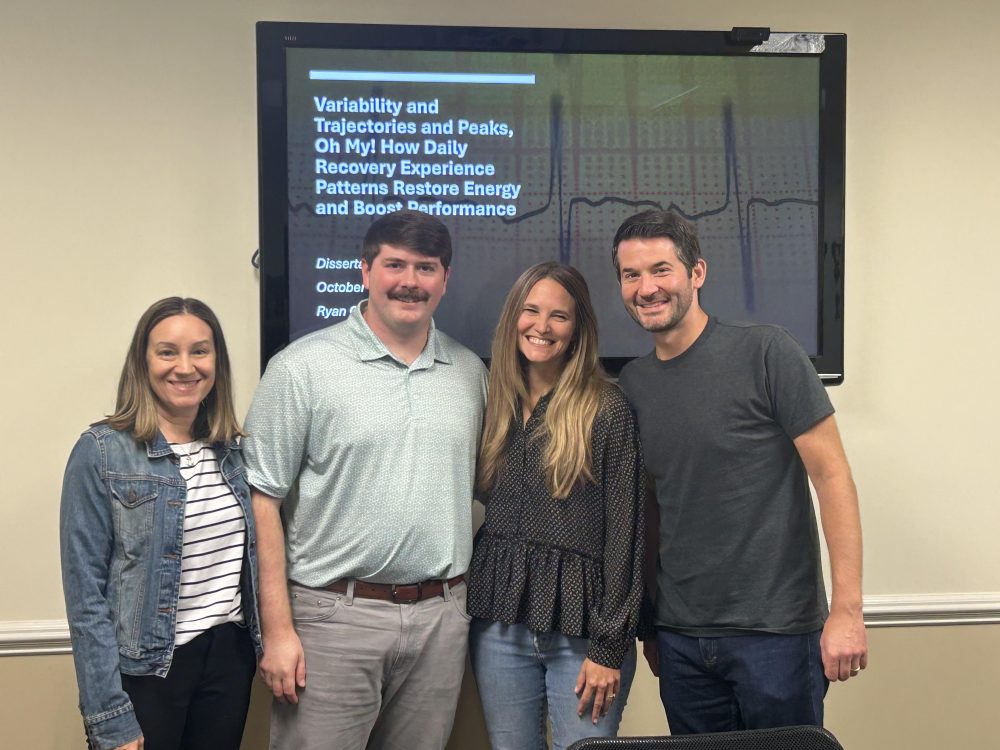
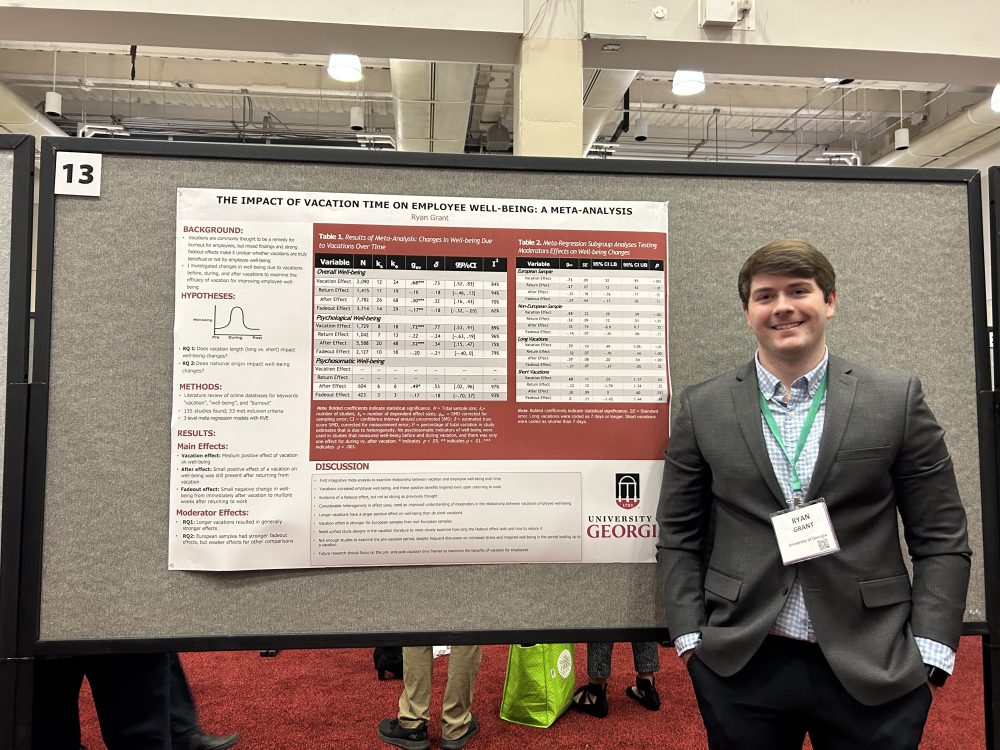
The publication also marks a significant personal milestone for Grant, who began the project as a master’s thesis five years ago. This is his second article published in the journal, with “I Need a Vacation: A Meta-Analysis of Vacation and Employee Well-Being,” published in Jan. 2025 and selected as the Editor’s Choice article for the July issue.
“This is the top journal in our field, so for us it really does feel like winning the Super Bowl,” Grant said. “There’s a lot of excitement and fulfillment because I’ve been working on this project for five years so it’s nice to see all that hard work from our research team pay off. I’m excited for people to read it and, hopefully, for it to help improve how people recover from their work stress.”
A new look at how workers unwind
Grant and co-authors Kristen Shockley, Auburn University; Fadel Matta, University of Georgia; and Malissa Clark, University of Georgia set out to understand how more than 300 employees recover from their ‘9 to 5’ during their ‘5 to 9.’
“We’re looking at what’s called work recovery, which is defined as how people unwind from stress, reduce strain and restore the energy that they lost due to work stress that day,” said Grant.
Past studies typically measured recovery once at the end of the day or the next morning, asking workers to provide an average of how much they relaxed or detached from work. Grant’s team took a more dynamic approach to examine how the recovery process ebbs and flows throughout the night.
In two experience-sampling studies, participants completed surveys throughout the evening, once every hour until bedtime in Study 1, and through a detailed evening reconstruction method in Study 2. This allowed the researchers to track how four key recovery experiences — detachment, relaxation, control and mastery — unfolded over time. Then, the team identified distinct patterns, or “profiles,” of how people recover across the evening.
Key Findings
Across more than 10,000 hours of observation, several patterns emerged.
Early and sustained recovery is the most beneficial
People who began the evening with high levels of detachment, relaxation and control and maintained them, reported more next-day energy, greater work goal accomplishment and lower fatigue levels. Grant describes this as “buying in bulk, Costco-style” because early investment in recovery pays off.
“It’s really, really important to disconnect and sever that mental or even behavioral connection to work as soon as possible,” he said.
High workloads delay recovery
Stressful days and heavy task loads pushed recovery later into the evening, suggesting that work stress doesn’t end when the workday does. About 50% of the time, people started the evening with low recovery levels that didn’t rise until late at night.
“If there’s a really high workload and you’re experiencing a lot of stress or anxiety around that, it doesn’t just end because the clock hits 5 p.m. and you’re going home,” explained Grant. “We will ruminate about these things because it makes you feel that you have a lot of unfinished tasks.”
Mastery experiences are rarely reported
Feeling effective at work can help people unwind sooner. At‑work mastery, or the feeling of accomplishment during the workday, was linked to earlier recovery in the evening.
Similarly, participating in activities before or after work that create a sense of achievement, such as doing a hard workout, practicing the piano or working on a woodworking project, have a positive impact on recovery. However, these activities were almost nonexistent after work, appearing in only 7–8% of hourly observations.
“These experiences of achievement, success and progress that you have after work, or in the morning before work, provide you with a sense of self-efficacy, self-esteem or confidence that you bring with you to work,” explained Grant. “This helps you perform better and reduces the stress you feel at work, carrying over to home that night. You have this ‘job well done effect’ so you’re not really bringing work and stress home with you.”
Implications for employees and organizations
The team’s findings highlight that it’s not how you finish the evening, it’s how you start it. Most people eventually reach similar levels of recovery by bedtime, but those who start strong reap more benefits the next day.
Grant and his co-authors recommend that employees build intentional rituals such as a commute routine, a brief reflection or a transition activity to help mentally disconnect from work earlier in the evening.
For organizations, the research underscores the importance of manageable workloads and opportunities for employees to end the day with a sense of accomplishment.
“When people have higher at-work mastery that day, they were more likely to belong to that beneficial profile that disconnected earlier in the evening,” said Grant. ”So providing opportunities for people to feel ‘I did well today’ or ‘I achieved a lot’ means they’ll be more likely to have this ‘job well done effect’ and recover earlier.”
A career milestone years in the making
Grant credits his co-authors, mentors and supporters for helping bring the project to fruition. He met the co-authors while obtaining a master’s degree and Ph.D. in industrial/organizational psychology from the University of Georgia. Shockley, the paper’s second author and his former advisor, played a central role in shaping the research.
“I’m thankful for all my co-authors, including my mentor, Kristen Shockley. She was instrumental, not only for this project, but throughout my entire time in graduate school and now growing into my career,” said Grant. “My parents have supported me every step of the way, and my fiancée, Sara, has put up with me, ironically, not recovering so I could study recovery.”
Next steps
Grant now incorporates the research into the classroom after joining UNC Charlotte in fall 2025. He currently teaches doctoral and undergraduate students in Research Methods courses how to conduct research and write academic papers, using his own articles as examples. At the master’s level, he teaches students in the Job Attitudes course to understand how engagement, motivation and burnout unfold in real time.
Grant is also working on upcoming research focused on developing a new measure of mastery experiences with support from the Purdue Center for Working Well, part of the Purdue University Daniels School of Business.
A follow-up article aimed at practitioners is already in the works, with Grant and his co-authors preparing a piece for Harvard Business Review.
Read the full article published in the Journal of Applied Psychology.
This study was partially funded by the National Institute of Occupational Safety and Health and Pilot Research Project through the Sunshine Education and Research Center at the University of South Florida. This study was supported by the Centers for Disease Control and Prevention. The Harbert College of Business at Auburn University funded Study 2 and Lia O’Malley aided the data collection for Study 1.
Written by Emily Hamm/Photos courtesy of Ryan Grant